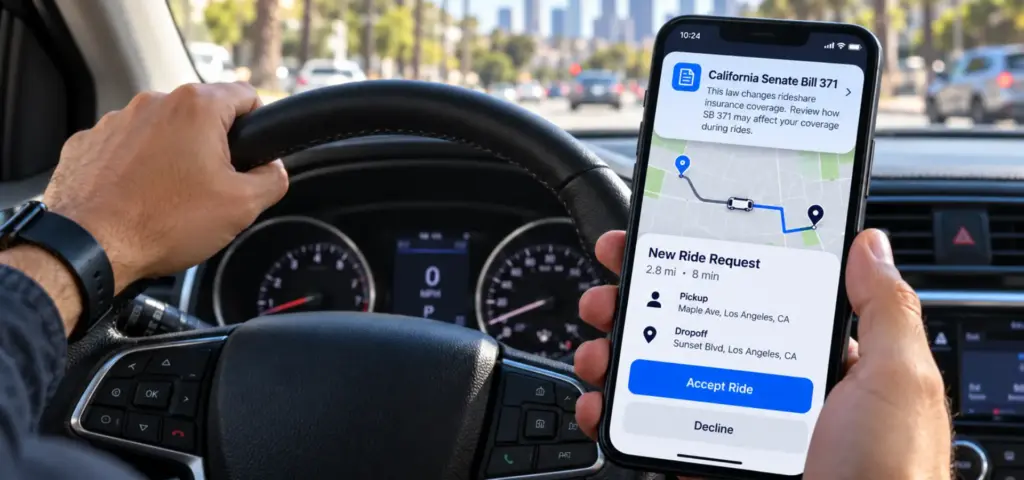
On January 1, 2026, California Senate Bill 371 changed the insurance requirements that apply to Uber, Lyft, and other transportation network companies. One of the most significant changes affects the amount of coverage that is available in Uber and Lyft accidents and for injured passengers, this change can directly affect how much compensation may be available for medical expenses, lost wages, pain and suffering, and other accident-related damages.
What Is the New California Uber Law, SB 371?
Governor Newsom signed SB 371 (Chapter 314, Statutes of 2025) on October 3, 2025, and it took effect January 1, 2026. The bill rewrote Public Utilities Code section 5433, the statute that sets the insurance requirements for transportation network companies like Uber and Lyft.
However, SB 371 was written to take effect only if AB 1340, the bill giving rideshare drivers a path to unionize, also became law. The two were signed together as part of a negotiated deal in Sacramento.
How SB 371 Changed Uber and Lyft Insurance Requirements
The biggest change was to uninsured and underinsured motorist (UM/UIM) coverage, which is the coverage that applies when another driver causes the crash and either has no insurance or doesn’t have enough.
Before 2026, Uber and Lyft had to carry $1,000,000 per incident in UM/UIM coverage from the moment a driver accepted a ride until the passenger got out of the car. However, starting January 1, 2026, that requirement dropped to $60,000 per person and $300,000 per incident.
The law also made UM/UIM coverage “solely the obligation” of the rideshare company, so a driver’s personal auto policy can’t be used to satisfy it.
What Coverage Did Not Change Under SB 371

A lot of what’s been written about SB 371 makes it sound like Uber’s $1 million policy disappeared, but that is a popular misconception. Third-party liability coverage is still $1 million while a driver is on the way to pick you up or has you in the car, but if your Uber driver runs a red light and causes the crash, that $1 million policy is still available for your injuries.
What shrank is the protection that matters when someone else causes the crash, because according to the Insurance Information Institute citing a 2025 Insurance Research Council study, about 20.4% of California drivers were uninsured in 2023, compared with 15.4% nationally. Meaning, roughly one in five cars on the road around your Uber has no insurance at all.
Many insured drivers don’t carry coverage much either, because California’s minimum liability limits only went up to $30,000 per person and $60,000 per accident on January 1, 2025, under SB 1107. A driver with a minimum policy has $30,000 to cover any one person they injure, but due to rising medical costs, a single night in a trauma unit can easily exceed that amount.
How Underinsured Motorist Coverage Works in California
To understand how much SB 371 matters, you have to look at how underinsured motorist coverage is calculated. Most articles about the new law skip this step, and it’s where riders lose the most money.
California’s UM/UIM rules are under Insurance Code section 11580.2, which outlines how underinsured coverage generally applies only when the at-fault driver’s liability limits are lower than the UIM limits. And the most UIM coverage will pay is its own limit, minus whatever the at-fault driver’s insurance already paid.
How SB 371 Affects Rideshare Accident Claims

SB 371 can reduce the amount of insurance available to passengers injured in Uber or Lyft accidents, because under the previous law, rideshare companies were required to carry much higher uninsured and underinsured motorist coverage, which could help cover damages when an at-fault driver had little or no insurance.
Under the new law, lower UIM limits may leave injured passengers with fewer options for recovering compensation beyond the at-fault driver’s policy. In some cases, the available insurance may fall well below the value of a claim involving serious injuries, medical expenses, lost wages, and other damages.
As a result, determining which insurance policies apply and whether additional sources of compensation are available has become even more important in California rideshare accident claims.
How SB 371 Affects Hit-and-Run Rideshare Accidents
Uninsured motorist coverage is also what pays when the driver who hit your Uber flees and is never identified. Under section 11580.2(b)(1), a hit-and-run claim generally requires proof of physical contact between the other vehicle and you or the car you were in, along with a police report within 24 hours.
Those requirements didn’t change, but the ceiling did. A passenger seriously hurt by a hit-and-run driver used to have access to $1 million in rideshare coverage, but under the new law it’s $60,000. If this happens to you, report it right away and keep a copy of any accident reports that has occurred.
Has SB 371 Lowered Uber and Lyft Fares?

So far, there is little evidence that SB 371 has significantly lowered Uber and Lyft fares in California. The law was promoted as a way to reduce rideshare prices by lowering insurance costs, but early fare data suggests riders have seen little change.
In June 2026, CalMatters reported that rideshare fares tracked by Gridwise remained roughly unchanged from the previous year. The average fare in May 2026 was approximately $4.67 per mile, compared with $4.70 per mile in May 2025, with several months showing similar or slightly higher prices.
Uber has said the insurance reforms are saving California riders millions of dollars, although the company has not publicly provided detailed figures showing how much individual fares have decreased. SB 371 requires rideshare companies to report average rider fares to the Governor and Legislature by February 1, 2027, which should provide a clearer picture of whether the law actually resulted in lower prices.
For now, SB 371 has clearly reduced certain rideshare insurance requirements, but whether those savings are being meaningfully passed on to Uber and Lyft passengers remains uncertain.
Does SB 371 Affect Rideshare Drivers
SB 371 can also reduce the insurance protection available to Uber and Lyft drivers who are injured during an active trip. Because rideshare UM/UIM coverage may protect both passengers and drivers, a driver hurt by an uninsured or underinsured motorist may now have access to significantly lower policy limits than under the previous law.
Depending on the circumstances, a rideshare driver may also have coverage through a personal auto policy or another applicable insurance policy. Identifying every potential source of coverage early can be important when injuries and damages exceed the rideshare policy limits.
How to Protect Your Rideshare Accident Claim Under SB 371

Although SB 371 reduced certain rideshare insurance limits, injured passengers and drivers may still have other sources of compensation. One of the most important steps is reviewing your own auto insurance policy. Personal uninsured and underinsured motorist coverage may apply even when you are injured as a passenger in another vehicle, and MedPay coverage may help with medical expenses regardless of fault.
You can also protect your claim by:
- Saving screenshots and receipts from the Uber or Lyft app to document that the trip was active at the time of the crash.
- Obtaining insurance information from every driver involved in the accident.
- Reporting the crash and identifying all potentially applicable insurance policies as soon as possible.
- Keeping track of California’s deadlines for pursuing uninsured or underinsured motorist benefits.
- Investigating whether another party, such as a commercial vehicle owner, government agency, or other third party, may also share responsibility for the accident.
Because SB 371 may leave a larger gap between your damages and the available rideshare coverage, identifying additional insurance and liable parties can be especially important after a serious accident.
SB 371 vs. SB 623: What’s the Difference?
SB 371 and SB 623 both affect California rideshare accident claims, but they address different issues. SB 371 changes the amount of insurance coverage that may be available after an Uber or Lyft accident, while SB 623 changes how certain medical expenses may be evaluated in rideshare injury claims.
SB 371 took effect on January 1, 2026, and affects rideshare insurance requirements, including certain uninsured and underinsured motorist coverage limits. SB 623 applies to crashes occurring on or after January 1, 2027, and addresses how medical damages are calculated in qualifying rideshare cases.
In short, a person injured in a 2026 rideshare accident may be affected by SB 371’s insurance changes, but not by SB 623’s medical billing provisions.
Contact a California Uber and Lyft Accident Lawyer

SB 371 works quietly. A lot of people assume Uber’s insurance will take care of them, accept whatever the adjuster offers, and find out later that their own policy, the other driver’s assets, or another responsible party could have covered much more. Once a release is signed, those options are usually gone.
At West Coast Trial Lawyers, we look at every source of coverage before anyone talks numbers: the rideshare policy, your personal coverage, the at-fault driver’s limits, and anyone else who shares responsibility.
If you or someone in your family was hurt in a rideshare crash anywhere in California, call us at (213) 927-3700 or send us a message for a free consultation.