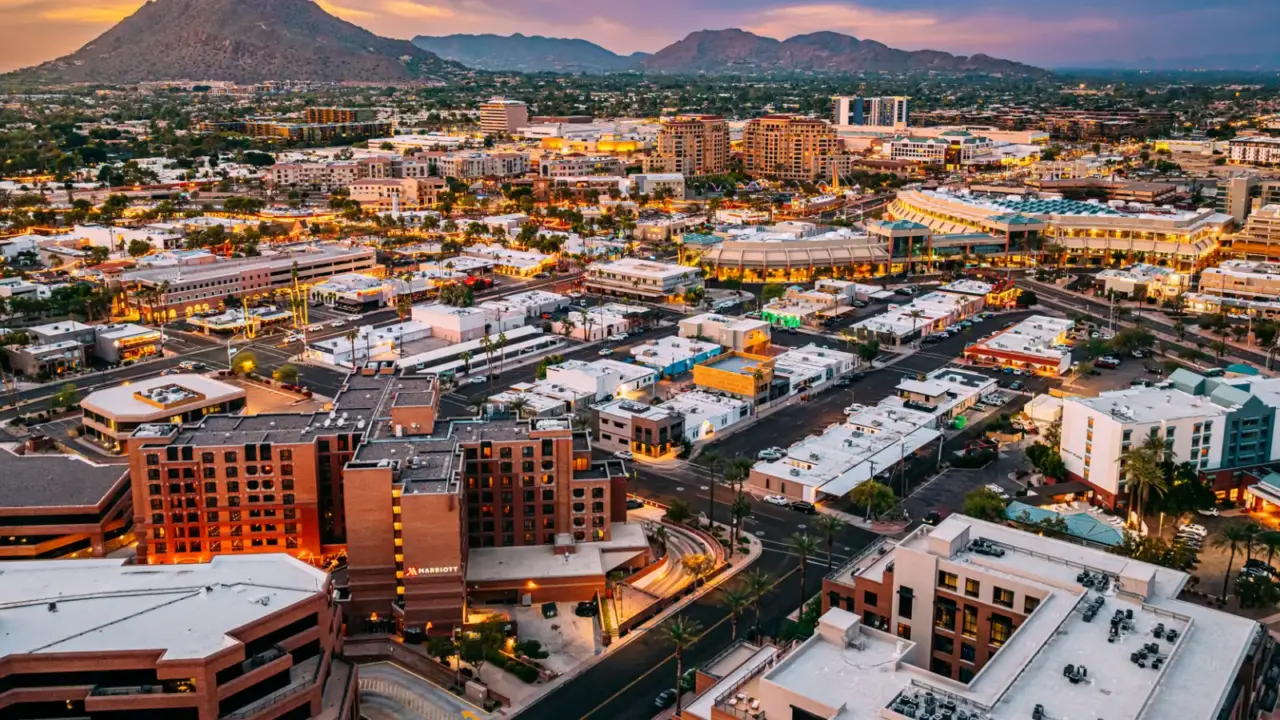
Maricopa County has some of the busiest and most dangerous intersections in Arizona, especially throughout the Phoenix metropolitan area. High traffic volumes, wide multi-lane roads, freeway access, commercial development, pedestrian activity, and complex turning patterns can all increase the risk of serious collisions.
According to Arizona crash data, Maricopa County consistently accounts for a large share of the state’s reported motor vehicle accidents. Some intersections stand out even more because of their crash frequency, roadway design, nearby shopping centers, transit activity, or connections to major highways. Understanding why these intersections are dangerous can help drivers avoid crashes.
1. 99th Avenue and Lower Buckeye Road
The intersection of 99th Avenue and Lower Buckeye Road recorded the highest number of crashes in the MAG study, with 429 reported collisions between 2018 and 2022. Unlike many major intersections in Phoenix, this location is controlled by a large multi-lane roundabout rather than a conventional signalized crossing.
The roundabout requires drivers to make several decisions within a relatively short distance. Motorists must select the appropriate approach lane, yield to vehicles already circulating, maintain proper lane position, and prepare for the correct exit. These movements can become particularly difficult when traffic volumes are high or when drivers are unfamiliar with multi-lane roundabout navigation.
The surrounding Lower Buckeye Road corridor has also experienced substantial residential and commercial growth. Nearby retail development, neighborhood traffic, buses, and delivery vehicles increase the number and variety of roadway users entering the area. For motorists traveling through west Phoenix, the combination of an unconventional intersection design and increasing local traffic creates a more complex driving environment than a typical signal-controlled intersection.
2. 67th Avenue and Indian School Road
67th Avenue and Indian School Road is one of west Phoenix’s most heavily traveled arterial intersections, because it recorded 256 crashes during MAG’s five-year study period. Indian School Road is an important east-west transportation corridor through Maryvale and the corridor is also being considered for the proposed West Phoenix light-rail extension, which would travel west along Indian School Road to 75th Avenue. That proposal reflects how heavily the road is used by commuters and transit riders.
The greatest danger comes from the number of simultaneous conflicts, because drivers turning left must cross several lanes, right-turning vehicles encounter pedestrians, and through traffic may enter the intersection at arterial speeds. Additionally, the size of the intersection also increases the amount of time pedestrians need to cross and the distance vehicles must travel before clearing the roadway.
3. 67th Avenue and McDowell Road
Although 67th Avenue and McDowell Road recorded fewer total crashes than several other intersections on this list, MAG ranked it first in the region for overall crash risk after considering crash frequency, severity, and collision type. One of the intersection’s most significant characteristics is its proximity to Interstate 10, because the freeway lies immediately south of the area, creating additional traffic from motorists entering or leaving the interstate.
Drivers approaching the intersection may be changing lanes to reach I-10, accelerating toward a freeway connection, or moving between local streets and regional travel routes. The surrounding land use adds another layer of complexity. Gas stations, retail properties, restaurants, multifamily housing, bus routes, and commercial driveways generate frequent turning and merging movements along both 67th Avenue and McDowell Road.
These conditions can create substantial differences in vehicle speed and direction. One driver may be slowing to enter a business while another is accelerating toward the freeway. Other motorists may be crossing several lanes to reach a turn pocket or attempting a left turn across opposing traffic. For accident investigations, this type of roadway environment can make factors such as lane position, signal timing, speed, and pre-collision vehicle movements especially important when determining how a crash occurred.
4. 75th Avenue and Indian School Road
The intersection is formed by two major arterial roads with several lanes of through and turning traffic. Its physical size creates long crossing distances for pedestrians and requires drivers to monitor traffic approaching from multiple lanes before completing turns.
Commercial and residential development surrounding the intersection also generates frequent vehicle movements throughout the day. Drivers regularly enter and leave nearby businesses, while buses and pedestrians use the Indian School Road corridor for local transportation. These activities increase the number of potential conflict points between through traffic, turning vehicles, cyclists, and pedestrians.
Furthermore, Indian School Road carries relatively fast-moving arterial traffic, which can increase both stopping distance and crash severity. Drivers approaching a changing traffic signal at higher speeds may be more likely to enter the intersection during a late yellow light, brake abruptly, or misjudge the time available to complete a left turn.
5. 75th Avenue and McDowell Road
Like several other high-crash locations in west Phoenix, 75th Avenue and McDowell Road combines a major arterial crossing with significant commercial development and convenient access to Interstate 10. Motorists traveling between I-10 and west Phoenix neighborhoods may use 75th Avenue as a north-south connection, producing additional merging and lane-changing activity near McDowell Road.
Large retail centers and other businesses surrounding the intersection further increase traffic complexity. Drivers may slow to enter shopping centers, exit parking lots into moving traffic, change lanes to reach a driveway, or cross several opposing lanes while making left turns. These movements can create significant speed differences between vehicles traveling through the intersection and those preparing to enter or leave commercial properties. Such conditions are commonly associated with rear-end, sideswipe, and turning collisions.
What Should You Do After a Maricopa County Intersection Crash?
After a car accident at a Maricopa County intersection, the first priority is safety and medical care. Call 911 if anyone may be injured, move to a safe location when possible, and seek prompt medical attention even if your injuries do not initially appear severe. If it is safe to do so, document the crash scene before important evidence disappears. Photographs or video should capture:
- Vehicle damage and final resting positions
- Traffic signals and signs
- Lane markings and turn lanes
- Crosswalks and pedestrian signals
- Skid marks, debris, and road conditions
- Nearby businesses, homes, or traffic cameras that may have recorded the collision
This evidence can become important in a Maricopa County personal injury claim, particularly when drivers disagree about who had the right of way, whether a traffic signal was violated, or where each vehicle was positioned before impact.
It is also important to preserve medical records, applicable police reports, repair estimates, wage-loss documentation, photographs, and communications with insurance companies. Avoiding common car accident claim mistakes, such as delaying treatment or making unnecessary recorded statements to an insurer, can help protect the value of a personal injury claim.
Who Is Responsible for an Arizona Intersection Accident?
Liability for an Arizona intersection accident generally depends on which driver or other party caused the collision. However, more than one person can share responsibility for an Arizona car accident. Under A.R.S. § 12-2505, Arizona follows a pure comparative negligence system, meaning an injured person may still recover compensation even if they were partially responsible for the collision, although their recovery can be reduced according to their percentage of fault.
Most Arizona personal injury lawsuits are subject to a two-year statute of limitations under A.R.S. § 12-542. However, claims involving government entities may be subject to substantially shorter notice and filing requirements.
Injured in a Maricopa County Intersection Accident?
A history of crashes at an intersection can help explain why a location may be difficult to navigate, but it does not by itself establish who is legally responsible for an individual collision. A successful personal injury claim generally depends on evidence showing how the accident occurred, who caused it, and how the crash resulted in injuries and financial losses.
West Coast Trial Lawyers can investigate a Maricopa County car accident by reviewing police reports, roadway conditions, traffic-signal information, available surveillance footage, witness statements, medical records, and insurance coverage. The firm can also address attempts by an insurance company to minimize injuries or shift an unfair share of fault onto the injured person.
People injured in crashes involving dangerous intersections, rear-end collisions, left-turn accidents, pedestrian impacts, roundabout crashes, or other motor vehicle collisions may be entitled to compensation for medical expenses, lost income, pain and suffering, and other accident-related damages.
For a FREE, no-obligation consultation, call (213) 927-3700 or send us a message.