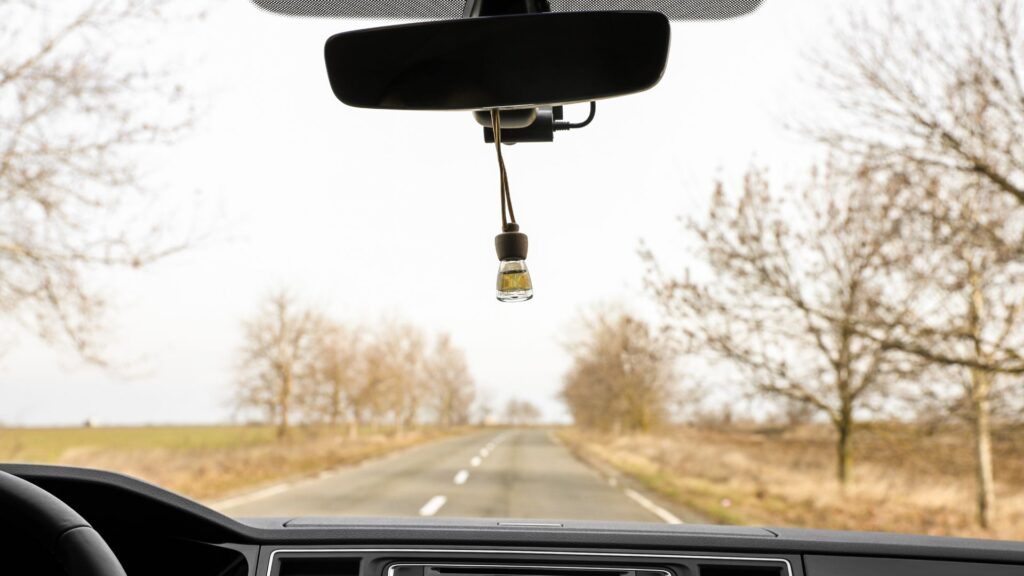
Most drivers have dangled something from their rearview mirror at some point – an air freshener, a graduation tassel, a parking pass. But rearview mirror laws across the United States can turn that small item into a reason for a traffic stop or a ticket. Here’s what you need to know before you hang things from your mirror.
Quick Answer: Can You Hang Things from Your Rearview Mirror?

In short, hanging items from your rearview mirror is restricted or illegal in most states when those items obstruct the driver’s field of vision. Even small obstructions can increase accident risk, and many officers treat a dangling object as reasonable grounds for a stop.
The rules vary significantly by state, for instance, states like Minnesota strictly ban rearview mirror items and make it illegal to hang anything from mirrors, regardless of size or material. Meanwhile, states like California and Texas only penalize objects that “obstruct or reduce” the driver’s clear view through the windshield or side windows.
Even common items such as air fresheners, rosaries, or a parking pass can justify a traffic stop if they block or appear to block visibility from the driver’s seat. With that in mind, if you’re unsure whether your state allows it, the safest move is to remove the item and avoid the risk entirely.
Rearview Mirror Requirements and Equipment Laws
Before discussing what you can hang from a mirror, it helps to understand what the law requires the mirror itself to do. Mirror laws for motor vehicles are governed by federal safety standards and state vehicle codes, and rearview mirror regulations aim to reduce blind spots and improve driver awareness.
Key equipment rules include:
- 200-foot rear visibility: Many state laws require mirrors to provide a clear view of the highway for at least 200 feet. A vehicle must reflect a view of at least 200 feet behind in Texas, and road safety laws typically require a clear view behind the vehicle for a minimum distance.
- Interior vs. exterior mirrors: Passenger cars must have an interior rearview mirror with unit magnification. A driver’s side exterior mirror of unit magnification is mandatory for vehicles, and many states mandate the driver’s side exterior mirror for vehicle registration.
- When side mirrors substitute: If the interior mirror view is obstructed (e.g., by cargo or a camper shell), state laws often require dual outside mirrors. A passenger-side outside mirror is required if the interior mirror does not provide adequate rear visibility. Vehicles obstructing rear view must have side mirrors too.
- Commercial vehicles: Commercial vehicles must have dual exterior rear-vision mirrors, typically checked during safety inspections.
- Federal standards: FMVSS No. 111 governs mirror specifications for new vehicles in the U.S., and federal standards require new vehicles to have a rear visibility camera system.
- Missing or damaged mirrors: Driving with a missing or shattered driver’s side mirror can result in a traffic infraction, even if you rely on side mirrors. State laws can differ significantly regarding vehicle equipment requirements, so check your local code.
State Laws on Rearview Mirror Obstructions and Hanging Items
The phrase “rearview mirror laws” covers both mandatory mirror equipment and bans on obstructing the driver’s view with hanging items. Most states use similar language, focusing on anything that “obstructs,” “materially impairs,” or “reduces” the driver’s clear view through the windshield or side windows.
Here’s how a few key states handle it:
- California (Vehicle Code § 26708): Prohibits placing objects on the windshield or near the rear view mirror that reduce the driver’s view. Enforcement depends on whether the object materially obstructs vision – not on the type of item.
- Texas (Transportation Code § 547.613): Bans objects placed on windshield or side windows that obstruct the operator’s clear view. Officers can pull you over solely for a suspected obstruction.
- Minnesota (§ 169.71): One of the strictest states, the statute prohibits any object suspended between the driver and the windshield, other than sun visors, rearview mirrors, and electronic toll devices.
- Illinois (625 ILCS 5/12-503): Prohibits objects that materially obstruct the driver’s view but explicitly prevents officers from stopping a person solely for a front-windshield obstruction, making it a secondary offense.
Rearview mirrors themselves are usually exempted from obstruction bans, but items attached to or hanging from them like beads, decorations, air freshener hanging tags are absolutely not automatically exempt. If you drive across state lines, be aware that what passes in one state may trigger a citation in another.
Common Hanging Items: Air Fresheners, Permits, and Decorations
The most common items people hang from their rearview mirror include paper air fresheners, graduation tassels, fuzzy dice, rosaries, lanyards, parking permits, and small plush toys.
Here’s why these items draw attention from officers:
- Air fresheners are the single most common items cited in obstruction stops. They sit centrally, tend to hang low, and swing with vehicle motion. Air fresheners are commonly cited for obstructing views because swinging items can intermittently block sightlines to pedestrians and cross traffic.
- Large or opaque objects like oversized handicapped placards, thick beaded chains, or bulky decorations create a material blind spot, especially at intersections.
- Bright or reflective items in peripheral vision can act as distractions. Distractions from hanging items can divert attention from driving, even when the object itself is small.
Self-check tip: Sit in the driver’s seat and look straight ahead. If any hanging object blocks your view of a pedestrian on the sidewalk, a traffic light, or cross traffic at a reasonable distance, it is both a safety issue and a potential legal issue. Remove it before you drive.
Is it Really Illegal to Hang an Air Freshener From Your Rear View Mirror?

According to the Vehicle Codes of California, Arizona, Texas, Illinois, Minnesota, and Pennsylvania, it is illegal to hang objects such as air fresheners on a rearview mirror because it is considered to be a visual obstruction. California is often the focus of rearview mirror law discussions because of Vehicle Code § 26708 and several appellate decisions that interpret it.
Prominent Judicial Rulings About Rear View Mirror Decorations
One of the prominent rulings about rearview mirror decorations was showcased in People v. White (2003). In this case, an officer pulled over a car due to an air freshener hanging from the rearview mirror, but the court ruled that it wasn’t a lawful stop because the officer did not provide enough specifics on how it obstructed a driver’s visibility.
However, several years later in People v. Colbert (2007), a court upheld a stop where a tree-shaped air freshener was found to violate Vehicle Code § 26708(a)(2) because the officer articulated how size and position obstructed the view. These cases show that enforcement depends on whether the officer can describe how the item reduced visibility.
Legal Consequences for Rearview Mirror Decorations
A police officer who spots something hanging from your rearview mirror may use it as a basis for a traffic stop, even if the item seems minor. What happens next depends on the state, the size of the object, and what else the officer observes.
- What officers look for: Size, position relative to the driver’s eye level, whether the item swings, and whether it blocks critical sightlines. An officer needs reasonable facts to justify the stop and not just a vague hunch.
- Type of citation: Most obstruction violations are non-criminal infractions with fines typically under $200. In some states like California, citations are often treated as an infraction and officers will issue a fix-it ticket to correct the violation and display proof.
- Pretextual stops: A simple stop for an air freshener hanging from a car mirror can escalate into checks on license, registration, insurance, seatbelt compliance, or signs of impaired driving. Civil rights concerns over this practice have pushed states like Illinois and Minnesota to reclassify obstruction as a secondary offense.
Safe and Legal Alternatives to Hanging Items on Rearview Mirrors
You can keep your car fresh and personalized without obstructing the windshield area. The key is to avoid hanging anything in the space between your eyes and the road. Practical alternatives include vent clips that are designed to attach directly to your AC vents or low-profile dashboard options that sit below the driver’s line of sight and outside airbag deployment zones.
How to Avoid Trouble: Best Practices for Drivers
Here are a few practical tips to stay safe and legal:
- Avoid hanging anything from your rearview mirror while driving, especially in areas where enforcement is high.
- Place parking permits or badges on the dashboard or upper corner of the windshield, where allowed by law.
- Remove sentimental or decorative items unless you’re parked or attending an event.
- Know your local ordinances. Some cities enforce more strictly than others.
Consult an attorney if you receive a citation or believe your rights were violated during a stop.
What Should I Do When I Receive a Rearview Obstruction Citation?

Keeping your windshield and mirrors unobstructed is the simplest way to avoid a ticket, reduce crash risk, and stay on the right side of rearview mirror laws no matter which state you drive through. Rearview citations can be easily solved and dismissed once you submit the necessary paperwork and pay the corrective fees at your local court.
However, if you are subjected to an unlawful traffic stop and would like to seek legal representation of the matter, contact us today by calling (213) 927-3700 or filling our contact form to schedule a free consultation with our compassionate and talented legal team.