If you’ve been injured and are considering a lawsuit, chances are you’ve heard the phrase “no win, no fee.” But what does that actually mean for your wallet? This guide breaks down how contingency fees work, what percentages to expect, and how to protect yourself before signing anything.
Quick Answer: What Is a Contingency Fee?
A contingency fee is a legal fee structure where your attorney agrees to handle your case without charging upfront fees. Instead, the lawyer’s fee is a percentage of the money you recover through a settlement or court judgment.
For example, if you’re hit by a distracted driver in a Los Angeles car accident and your attorney secures a $200,000 settlement on a contingency fee basis, the firm takes its agreed share from that recovery. Contingency fees allow clients to pay only if they win, which means if there is no recovery, the contingent fee is typically $0. However, before a lawyer works on a case, everything must be spelled out in a written contingency fee agreement and agreed upon.
How Contingency Fees Work in a Personal Injury Case?
A personal injury contingency fee is usually set out in a written agreement signed by the client and attorney. The agreement should explain the percentage the lawyer will receive, how case costs will be handled, and when deductions will be made from the recovery.
A typical process looks like this:
- The injured person hires a lawyer under a written contingency fee agreement that spells out the percentage, how expenses are handled, and your obligations.
- The law firm investigates the claim, gathers evidence, communicates with insurers, negotiates with the at-fault party, and advances all litigation expenses during the client’s case.
- If the case settles or results in a verdict, the attorney’s fee is calculated from the recovery.
- Case costs, medical liens, health insurance reimbursement claims, and other deductions may be resolved.
- The remaining amount is distributed to the client.
Most personal injury law firms use standard percentages that increase at set stages, a structure commonly called a sliding scale, meaning the percentage may rise if a lawsuit is filed or the case goes to trial.
Additionally, it is important for clients to understand attorney’s fees and case costs are not always the same thing. Attorney’s fees compensate the lawyer for legal work, meanwhile case costs are expenses incurred while building and pursuing the claim.
When Are Contingency Fees Used?

Not every legal matter qualifies for a contingency fee arrangement, because contingency fees are most often used in civil litigation where monetary damages are sought. Here are the most common case types:
- Car and truck accidents– the most frequent use of contingency fees, where injured people sue at-fault drivers or their insurance carriers.
- Slip and fall/premises liability– cases where property owners fail to maintain safe conditions.
- Medical malpractice– claims against doctors, hospitals, or other providers for negligent care.
- Wrongful death– lawsuits filed by families who lost a loved one due to someone else’s negligence.
- Workplace injury and employment discrimination– some attorneys accept these on a contingency basis when the potential compensation justifies the risk.
Contingency fees are not allowed in criminal cases in most U.S. jurisdictions and they are also barred or heavily restricted in family law matters like divorce, child custody, and most support disputes because of the fact that the final remedy is not aimed for financial compensation.
Personal injury claims are particularly suited to this form of payment because damages are quantifiable, the defendant often carries insurance, and recovery can be substantial enough to justify the attorney’s risk.
How Much Is a Typical Contingency Fee?
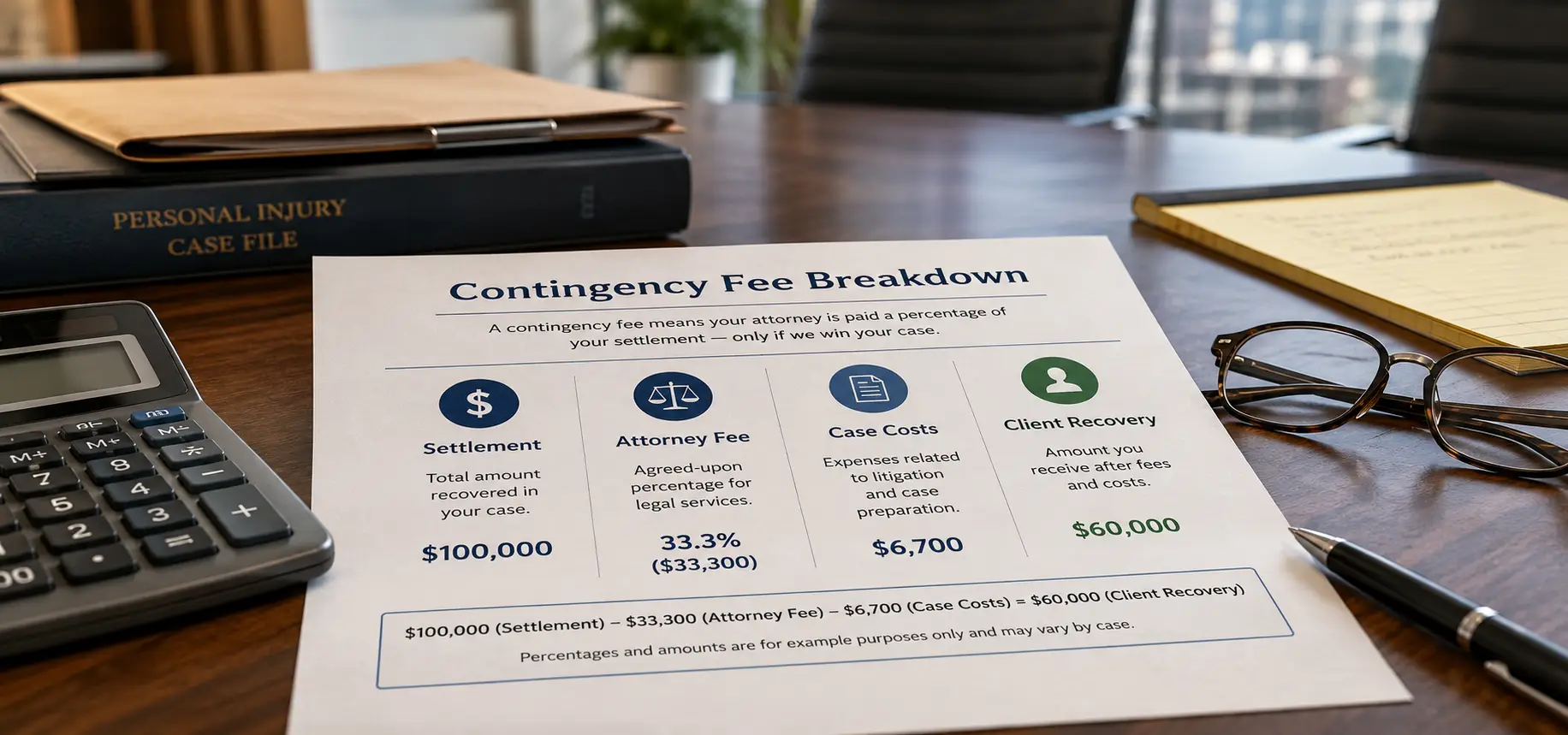
Contingency fees in personal injury cases often range from about 25% to 40% of the recovery, but the exact percentage depends on the law firm, case type, difficulty, expected litigation costs, and whether the case settles early or goes to trial.
Some agreements use one flat percentage while others use a tiered structure where the percentage changes depending on how far the case progresses. For example, the percentage may be lower if the case settles before a lawsuit is filed and higher if litigation, arbitration, or trial becomes necessary.
Common factors that may affect the contingency fee include:
- Whether liability is clear or disputed
- The severity of the injuries
- The amount of available insurance coverage
- Whether expert witnesses are needed
- Whether the case requires a lawsuit
- Whether the case goes to trial or appeal
- The amount of time, risk, and resources the law firm must invest
Regardless of the percentage, the attorney or law firm must ensure that all contingency fees are reasonable under professional responsibility rules, considering risk, complexity, and expected time. What matters most is whether the agreement is clear, lawful, and appropriate for the work and risk involved.
How Contingency Fees Differ by State
Contingency fees are common in personal injury cases across the country, but the rules are not identical in every state. Most states allow personal injury lawyers to work on a contingency fee basis as long as the fee is reasonable, clearly explained, and put in writing.
The practical takeaway is that contingency fees may look similar from state to state, but the details matter. A standard car accident contingency fee agreement in California may not satisfy Oregon’s 24-hour rescission requirement, Colorado’s detailed disclosure rules, or Nevada’s healthcare professional negligence cap.
Ethical Rules and Written Contingent Fee Agreements
Contingency fees are governed by ethics rules designed to protect clients. Under ABA Model Rule 1.5 and equivalent state regulations, attorneys must meet specific requirements when offering legal services on a contingency basis.
- A written contract for a contingency fee agreement is required: The document must clearly state the percentage at each stage, what legal costs include, and whether expenses are deducted before or after the fee calculation.
- Contingency fee agreements must specify the percentage and handling of expenses. Without this level of detail, the agreement may be unenforceable.
- In many states, the lawyer must provide a written settlement statement at the case’s conclusion, itemizing attorney fees, costs, and the client’s net recovery.
- Criminal defense and most family law matters involving custody or support cannot be handled on a contingency fee basis under ethics rules.
- Legal fees must be reasonable. Six U.S. states require court approval for attorney fee reasonableness, and courts in other jurisdictions can reduce excessive contingent fees even when a signed agreement exists.
- Clients have every right to discuss the terms, negotiate the fee within legal limits, and seek a second opinion before they accept and sign.
Pros and Cons of Contingency Fees for Clients
Contingency fees offer real advantages, but they come with trade-offs that most people should understand before hiring a law firm.
Some clients in complex cases prefer hybrid models (reduced hourly rates plus a smaller contingent fee), though pure contingency remains the standard in typical personal injury and wrongful death matters. Before signing, ask your attorney to walk through sample numbers for best-case, likely, and worst-case outcomes so you understand what you may actually take home.
Questions to Ask Before Signing a Contingency Fee Agreement
The quality of your law firm and the clarity of your written agreement matter just as much as the percentage itself. A lower fee means nothing if the firm lacks the resources or experience to obtain a fair result in your lawsuit.
Before you sign, ask these questions:
- What is the exact percentage at each stage (pre-suit settlement, after filing, trial, appeal)?
- How are legal costs handled – deducted before or after the fee? Who is responsible if there is no recovery?
- What happens if you terminate the lawyer or the firm withdraws from the case?
- How often will you receive status updates and cost reports on your claim?
- Compare not just percentages but also the firm’s track record. Ask about verdict and settlement history for cases similar to yours in your local court system.
- Reputable firms present a clear contract, avoid hidden fees, and encourage you to review the document carefully or take it home overnight before signing.
- In large or complex cases where projected recovery is high, clients can often negotiate certain terms within legal and ethical bounds.
Speak With a Personal Injury Lawyer on a Contingency Fee Basis

A contingency fee can give injured people access to legal representation without paying attorney’s fees upfront. But the details matter. Before signing any agreement, make sure you understand the percentage, case costs, deductions, and what happens if there is no recovery.
West Coast Trial Lawyers represents injured clients in accident and injury claims on a contingency fee basis. If you were hurt because of someone else’s negligence, our team can review your case, explain your legal options, and discuss the fee agreement before you make a decision. The future of your claim starts with understanding exactly what you’re signing.
Call (213) 927-3700 or complete our online contact form to schedule a free consultation.