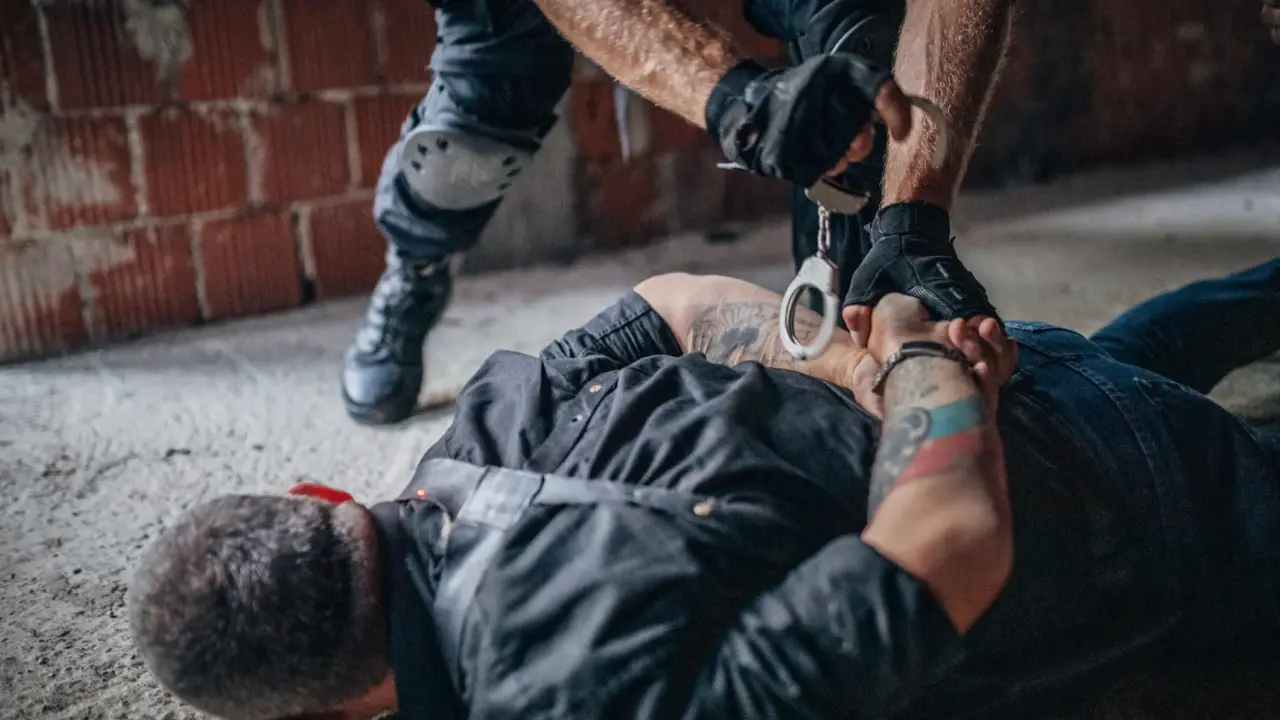
Losing a loved one during a police encounter is one of the most devastating experiences a family can face. Beyond the immediate grief, families are often confronted with confusion, conflicting narratives from law enforcement agencies, and urgent legal deadlines that can significantly impact their ability to seek justice.
When law enforcement officers use excessive force, act negligently, or violate constitutional rights in a way that results in death, California law allows surviving family members to pursue accountability through wrongful death claims, survival actions, and civil rights lawsuits.
At West Coast Trial Lawyers, we take the legal burden off your shoulders so you can focus on your family. Our team moves immediately to protect your case, preserving body-cam and surveillance video, 911/dispatch audio, medical and jail records, and witness statements before they disappear and ensure your chances of holding those responsible accountable for their actions.
Call (213) 927-3700 or send a message for a free, confidential consultation with an experienced attorney today.
Why Families Choose Us for Police Brutality Cases
In California, police brutality cases are uniquely complex because they often involve overlapping legal frameworks, including state wrongful death law, federal constitutional law, and statutory civil rights protections. At West Coast Trial Lawyers, we have a proven history of representing families whose loved ones were fatally wounded by negligent police officers.
- Top Tier Legal Roster, all in California- A dedicated team of 20+ attorneys and 100+ staff handles your case in-house from our California offices. No outsourcing, just direct support and fast communication.
- Trial-tested leadership- Led by award winning Super lawyers with extensive courtroom experience, trusted by thousands of clients across the west coast.
- Top-tier training- Our attorneys have Exceptional Legal backgrounds (including accreditations from Law Schools like Harvard) paired with investigators and experts who know police-practice standards.
- Transparent, client-first approach- Free consultation, no upfront costs, and you pay nothing unless we win. We advance all case expenses and handle claims paperwork at no extra charge.
When you hire us, you get attorneys who understand how impactful these claims are and are committed to delivering the justice your family deserves.
The Legal Definition of a Wrongful Death Caused by Police in California
Under California Code of Civil Procedure § 377.60, a wrongful death occurs when a person dies as a result of another party’s wrongful act, negligence, or misconduct. When the responsible party is a police officer or law enforcement agency, the claim often expands beyond traditional negligence into the realm of constitutional violations.
These cases typically arise when officers engage in conduct such as excessive force, unlawful detention, failure to provide medical care, or dangerous enforcement tactics that directly lead to a fatality.
In many situations, families pursue not only a wrongful death claim, but also a survival action under California Code of Civil Procedure § 377.30, which allows recovery for damages the deceased suffered before death, including pain and suffering.
The Legal Standard for Police Use of Force

The central legal issue in most police-related wrongful death cases is whether the officer’s actions were lawful under both federal and California law. Under Graham v. Connor, courts evaluate police use of force under the Fourth Amendment’s “objective reasonableness” standard.
This means that the officer’s actions must be judged from the perspective of a reasonable officer on the scene, taking into account factors such as the severity of the suspected crime, whether the individual posed an immediate threat, and whether they were resisting or attempting to flee.
The U.S. Supreme Court further clarified limits on deadly force in Tennessee v. Garner, holding that officers may not use deadly force against a fleeing individual unless that person poses a significant threat of death or serious bodily harm to others.
What is California’s Standard for its Police Department?
To some people’s surprise, California law actually imposes an even stricter standard when compared to Federal law. According to California Penal Code § 835a, deadly force may only be used when it is necessary to defend against an imminent threat of death or serious injury.
Importantly, California law allows courts to consider not only the moment force was used, but also the officer’s conduct leading up to that moment, including whether alternative tactics such as de-escalation, distance, or less-lethal methods were available but not used.
This principle was reinforced in Hayes v. County of San Diego, where the California Supreme Court held that an officer’s pre-shooting conduct can be relevant in determining liability. This means that even if force appears justified in the final seconds, earlier decisions by officers may still render the use of force unlawful.
Can You Sue the Police (Or the City) for a Loved One’s Death?

Families can pursue claims against both individual officers and, in some cases, the city or law enforcement agency. However, it is important to note that most cases involve two layers of legal claims.
Layer 1: California Claims
The first layer consists of California state law claims, including wrongful death and survival actions, which focus on the financial and emotional losses suffered by the family. An experienced wrongful death attorney will examine the facts and will let you know about technicalities and confirm eligibility with you
Layer 2: Civil-Rights Claims
The second layer involves federal civil rights claims under 42 U.S.C. § 1983, which allows families to seek accountability when constitutional rights have been violated. However, under Monell v. Department of Social Services, a municipality can be held responsible when a death results from a policy, pattern of misconduct, or failure to properly train or supervise officers. Additionally, California’s Bane Act also provides an additional avenue for recovery when rights are violated through threats, intimidation, or coercion.
Common Signs of Unlawful Police Action
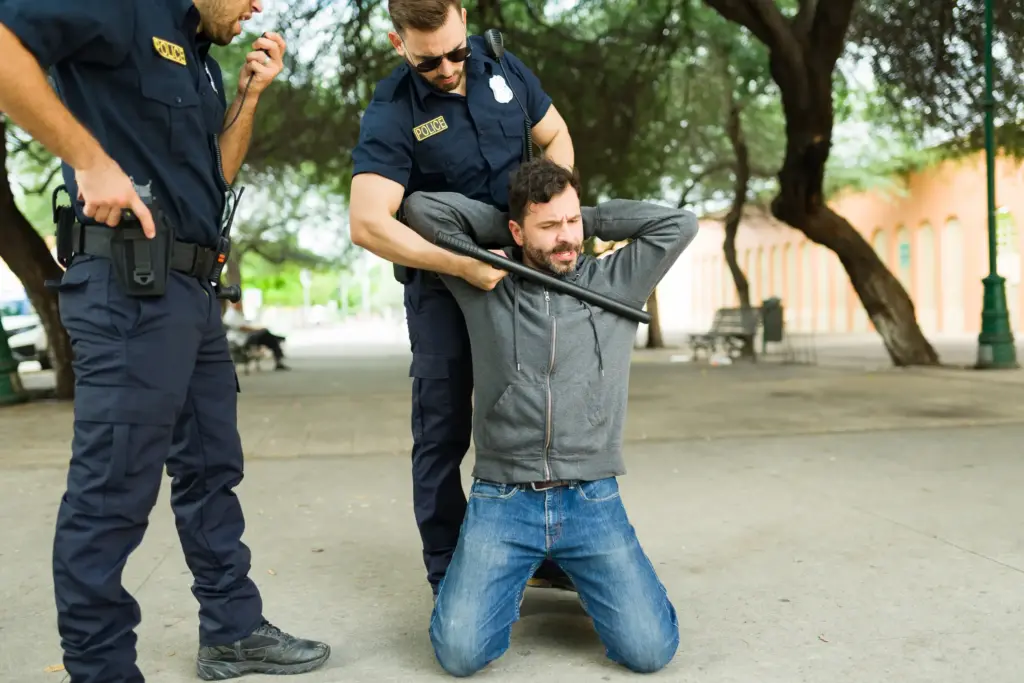
Certain patterns often indicate that a police-related death may involve unlawful conduct. Some of the most common examples that often raise these issues include the following:
- A shooting
- Neck restraint
- Longer than usual prone restraint
- The denial of medical care while in custody
- Repeated taser shots
If an unarmed civilian is killed by police gunfire or through other methods when safer, feasible alternatives were available, California’s Attorney General investigates separately under AB 1506 which can generate interviews, forensic work, and internal policy findings.
How Often Police Brutality Happens In California
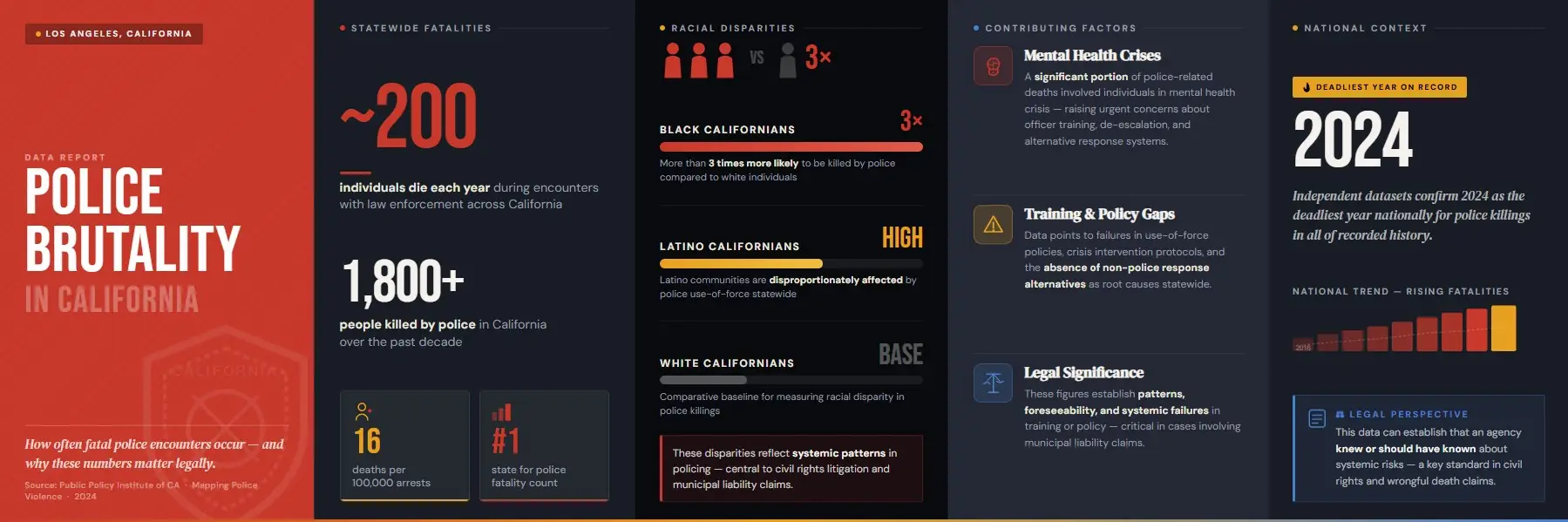
Understanding how often fatal police encounters occur in California provides important context for these cases. Data from the Public Policy Institute of California shows that nearly 200 individuals die each year during encounters with law enforcement across the state, equating to approximately 16 deaths per 100,000 arrests.
Over the past decade, nearly 1,800 people have been killed by police in California, making it one of the states with the highest number of police-related fatalities in the country. On top of it all, independent datasets show 2024 as the deadliest year on record nationally for police killings.
These statistics also reveal troubling disparities as such the following:
- Black individuals in California are more than three times as likely to be killed by police compared to white individuals
- Latino communities are also disproportionately affected by police brutality.
- A significant number of police-related deaths have involved individuals experiencing mental health crises, raising concerns about training, de-escalation practices, and the availability of alternative response systems.
From a legal standpoint, these figures are not just statistics, but they are often used to demonstrate patterns, foreseeability, and systemic failures in training or policy. In cases involving municipal liability, this broader data can play a critical role in establishing that a law enforcement agency knew or should have known about the risks associated with its practices.
How Long Do Families Have to File a Claim for Police Brutality
Time is one of the most critical factors in wrongful death cases involving police and as such, there are two deadlines families will need to pay attention to.
Clock 1- Government Claim (state-law claims against a city/county/agency):
For California claims like wrongful death, negligence, and many Bane Act claims, you must first file a Government Claim within 6 months of the incident. Miss this, and your state-law claims can be barred even if the lawsuit deadline hasn’t arrived. (Gov. Code §911.2)
Clock 2- Lawsuit Deadlines:
- Wrongful death / personal injury statute: 2 years from the date of death.
- After the Government Claim– If the agency sends a written rejection, you have 6 months from that letter to file suit and if the agency doesn’t send a written rejection, you have 2 years from the incident to file suit. (Gov. Code § 945.6)
What Damages Can Your Family Recover?

Families may be entitled to recover both economic and non-economic damages. Economic damages include lost financial support, future earnings, and funeral expenses, while non-economic damages address the emotional impact of the loss, including the loss of companionship, care, and guidance.
Through survival actions and civil rights claims, families may also recover damages for the decedent’s pain and suffering prior to death. In cases involving particularly egregious misconduct, punitive damages may be awarded against individual officers to punish wrongful conduct and deter future violations. While public entities are generally immune from punitive damages, individual officers can still be held personally accountable under federal law.
How We Prove These Cases

Proving a wrongful death case involving police requires a detailed and immediate investigation. At West Coast Trial Lawyers, here is how we handle police brutality cases:
- First, we grab and save the fragile proof, body-cam and 911 audio, nearby videos, scene photos, medical/autopsy records, policies, and witness accounts.
- We line it all up by time to show, second by second, what really happened.
- Then we compare those facts to the rules officers must follow under California and federal civil-rights law, flagging things like no immediate threat, no warning when one was possible, or safer options that were ignored.
- Independent doctors and police-practices experts help connect the tactics to the cause of death.
- We document your family’s losses such as income, care at home, and the love and guidance taken away.
- If the proof shows a bigger problem (bad training or a pattern), we also hold the city responsible and file the required government claim, bring the civil-rights lawsuit, push for a fair settlement, and are ready for trial if that’s what it takes.
This comprehensive approach ensures that every aspect of the case is thoroughly examined and presented.
Step-By-Step Guide if This Happened to Your Family
These are practical steps you can take for today, this week, and over the next few months to protect your loved one’s memory and your legal rights.
Today / This Week (0–7 days)
- Choose one family point person- This avoids mixed messages and lost details.
- Write down what you know- Date, time, location, officers/agencies involved, witnesses, and anything the family or neighbors saw or recorded.
- Save evidence immediately- Photos of injuries and the scene, clothing, bullet fragments, medical bracelets, hospital discharge papers, jail wristbands, and any texts/voicemails. Back everything up in two places.
- Find and copy nearby videos- Ask neighbors and businesses for Ring Cam or or other surveillance video before it is overwritten. Save to a separate drive.
- Send “Preserve All Evidence” notices- Email + certified mail to the police/sheriff, city attorney/risk management, 911/dispatch center, coroner/ME, and any jail/medical facility. Ask for a litigation hold on body-cam, dash-cam, CAD/dispatch logs, 911 audio, crime-scene photos, use-of-force reports, and officer personnel/training records. Keep copies of what you sent.
- Autopsy and medical records- Ask the coroner about the autopsy timeline and how to request the full report (including toxicology). If you’re considering an independent autopsy, discuss timing before burial/cremation.
- Social media rules- Avoid posting case details online; screenshot any relevant public posts and set profiles to private.
Next Few Weeks (1–4 weeks)
- Request key records- File California Public Records Act (CPRA) requests for: body-cam/dash-cam metadata, 911 audio and CAD logs, incident and use-of-force reports, scene photos, relevant policy/training bulletins, and the names/badge numbers of involved officers. (Agencies may delay while investigations are pending—requesting now preserves your place in line.)
- Identify and contact witnesses- Get names, phone/email, and short written statements while memories are fresh.
- Secure your loved one’s devices/accounts- Preserve phones and cloud accounts without altering contents.
- Start the estate step- A survival claim requires an estate representative. Begin the process to appoint a personal representative so you can request records and pursue claims on the decedent’s behalf.
- Gather “loss” documents- Pay stubs, tax returns, benefits info, proof of childcare/household services your loved one provided, certificates, photos, and videos that show who they were to your family.
Deadlines & Paperwork (by Month 6, sooner is better)
- Remember the two clocks- The Government Claim that must be filed within 6 months of the incident and the Lawsuit Deadlines that are generally 2 years for wrongful death in California and for federal civil-rights claims.
- Keep every receipt- Funeral and memorial costs, counseling, travel, time off work, save invoices and proof of payment. (California Victim Compensation may help with some expenses, be sure to apply early.)
Talk to an Experienced California Wrongful Death Attorney Today

If you’re here, you’ve already been carrying too much. Let us listen, explain your options and carry the legal weight so you can focus on your family. We’ll protect the deadlines and pursue full accountability and seek justice on your loved ones behalf. Our legal team has collected over 1.7 Billion from negligent defendants and we’ll bring that same legal tenacity to your case.
Call (213) 927-3700 or send a message for a free, confidential consultation with an experienced California Wrongful Death Lawyer. We’ll explain your options and act fast to preserve evidence.
Frequently Asked Questions About Wrongful Death By Police Cases
What Standard Do Courts Use to Judge Force?
Federal courts apply Graham’s objective reasonableness and Garner’s limits on deadly force; California’s §835a adds a “necessary to defend human life” rule for deadly force.
Do I Have to File a Special Notice Before Suing?
Yes for state-law claims against a city/county (six-month Government Claim). Civil rights claims do not require that notice, but shares the two-year limitations period in California.
Are Punitive Damages Available In These Types of Cases?
Against individual officers under federal civil rights claims, potentially yes. Against the city, no public entities are immune.
What Kinds of Compensation Are We Talking About?
Wrongful-death compensation for support, services, and companionship; survival damages for the decedent’s own losses, including pre-death pain and suffering under current California law.
How Long Will a Police Brutality Case Take?
Timelines vary with investigations, expert work, and court schedules. With that in mind, these cases can take anywhere between a couple of months to several years.
How Much Can My Family Recover in a Wrongful Death by Police Lawsuit?
Damages after a wrongful death claim involving the police will vary. For example, according to the Washington Post, settlements vary anywhere from $7,500 to $8.5 million. The median was reported as $1.2 million. This news report further stated that families collected greater damages by foregoing a trial and settling. Finally, very few cases have ever been brought against individual police officers.