
Nevada’s sexual assault law is one of the harshest in the country, with sentences that start at life with the possibility of parole and climb from there. But it is also narrower in one specific way that surprises a lot of survivors: Nevada’s sexual assault statute requires sexual penetration. Non-penetrative sexual contact, even when it is clearly nonconsensual and harmful, is prosecuted under different laws with very different penalties. Understanding where that line falls matters a lot, because what survivors think of as sexual assault and what Nevada’s NRS 200.366 covers are not always the same thing.
If you are in immediate danger, call 911. If you need to talk to someone right now, the National Sexual Assault Hotline is available 24/7 at 1-800-656-HOPE (4673), and the Nevada Coalition to End Domestic and Sexual Violence maintains a directory of advocates and crisis services across the state.
How Nevada Defines Sexual Assault
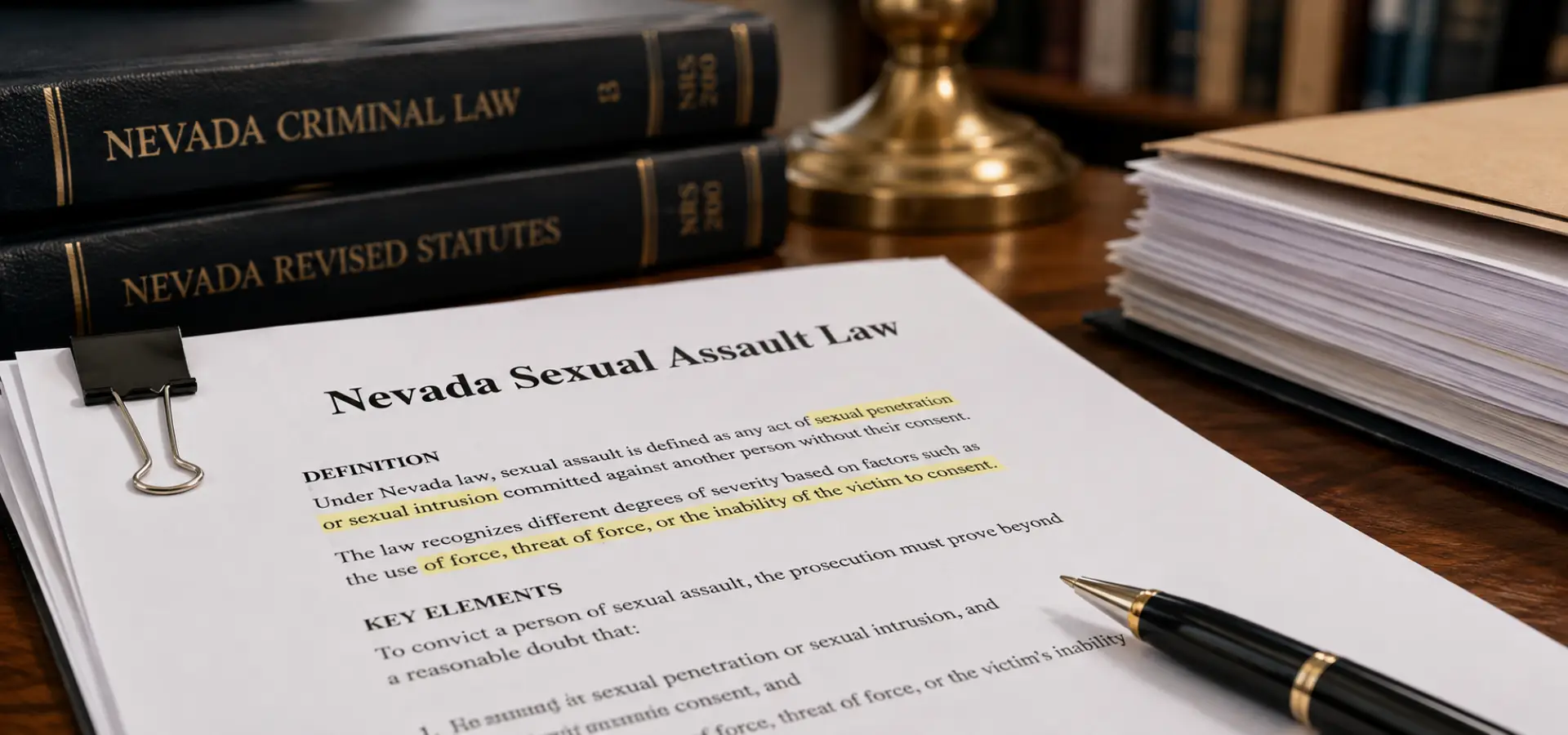
Under NRS 200.366, the statute outlines that a person is guilty of sexual assault if they:
- Subject another person to sexual penetration against the will of the victim
- Force another person to make a sexual penetration on themselves, another person, or an animal, against the victim’s will
- Act under conditions where the perpetrator knows or should know the victim is mentally or physically incapable of resisting or understanding what is happening
- Commit sexual penetration upon a child under 14, or cause a child under 14 to make a sexual penetration
Nevada’s statute is sometimes referred to in everyday language as the state’s rape law, but the Nevada Supreme Court and prosecutors regularly use the term interchangeably with sexual assault. The distinction matters more in courtroom language than in survivor experience.
A few things stand out about Nevada’s approach to sexual assault claims, the most important being that the statute is comparatively short, focusing on a single core crime rather than a graded scheme. To be concise, the law requires penetration in order for it to be categorized as sexual assault, which sets it apart from many other states, and the penalties are severe to a degree that is unusual even for serious felonies.
What “Sexual Penetration” Means Under Nevada Law
Under NRS 200.364, the term “sexual penetration” covers vaginal, anal, or oral intercourse, as well as any insertion (however slight) of any part of a person’s body or any object into the genital or anal openings of another person.
This definition is broad enough to capture a wide range of conduct, but it has a hard floor. If there was no penetration, NRS 200.366 does not apply, even if the conduct was clearly sexual and clearly nonconsensual. That distinction alone changes which charge can be filed, how serious the penalty is, and how the case is investigated.
What Does it Mean in Practice?
For example, any situations or incidents where there is forced oral, anal, or vaginal intercourse falls, penetration with an object, or forcing the victim to perform penetration on themselves or another person falls under sexual assault.
However, nonconsensual groping, fondling, or unwanted touching of intimate areas without penetration is not sexual assault under NRS 200.366. That conduct is generally charged as open or gross lewdness under NRS 201.210, which typically results in a gross misdemeanor with penalties capped at one year in jail and a $2,000 fine
What Counts as Consent Under Nevada Law

In Nevada, the lack or the inability to consent is a highly common scenario that frequently occurs in local sexual assault claims and the state outlines the definition in NRS 200.366. With that in mind, any of the following situations are instances where a victim is considered unable to consent under Nevada law:
- The victim is unconscious or asleep
- The victim is physically restrained or otherwise prevented from resisting
- The victim is mentally incapacitated due to alcohol, drugs, or another substance
- The victim has a mental disorder, mental defect, or developmental disability that prevents them from understanding the nature of the act
- The victim does not understand what is happening because of deception about the nature of the act
- The victim is under 14 years old (consent is legally impossible regardless of circumstances)
Furthermore, silence, a prior sexual relationship, and marriage is not deemed as consent under Nevada law. The state has a separate statute, NRS 200.373, that explicitly criminalizes sexual assault between spouses. Consent obtained through deception about what is actually happening is not legal consent.
What a Sexual Assault Conviction Looks Like in Nevada
Sexual assault is a Category A felony under NRS 200.366, which is the most serious felony classification Nevada has. Category A felonies are reserved for crimes that the states considers among the most serious in the criminal code, and the sentencing structure for sexual assault reflects that.
The base penalties depend on whether the victim was an adult or a child, whether substantial bodily harm resulted, and whether the perpetrator has a prior sex offense conviction:
- Adult victim, no substantial bodily harm: Life in prison with parole eligibility after a minimum of 10 years served
- Adult victim, substantial bodily harm: Life in prison without the possibility of parole, or life with parole eligibility after a minimum of 15 years
- Victim under 16, no substantial bodily harm: Life in prison with parole eligibility after a minimum of 25 years (35 years if victim is under 14)
- Victim under 16, substantial bodily harm: Life without the possibility of parole
- Repeat offender against a child under 16: Life without the possibility of parole (mandatory)
Beyond the prison sentence, Nevada imposes mandatory lifetime sex offender registration at Tier III under NRS 179D.117. Tier III is the highest classification, requiring quarterly in-person registration updates with law enforcement, public listing on the state sex offender registry, residency restrictions, and significant employment limitations that cannot be ended through expungement or record sealing regardless of how much time passes or how the rest of their life unfolds.
How Nevada Handles Other Sex Crimes

Nevada has a separate framework of laws that handle other forms of sexual misconduct. Understanding these matters is important because survivors sometimes assume that without a sexual assault charge, nothing can happen legally. However, Nevada criminalizes a wide range of sexual conduct under different statutes, including:
- Open or gross lewdness (NRS 201.210): Nonconsensual sexual touching that does not involve penetration. Gross misdemeanor for first offense (up to 364 days jail and $2,000 fine), Category D felony for repeat offenses
- Statutory sexual seduction (NRS 200.368): Sexual penetration with a person under 16 by someone 18 or older, where force is not used. Penalty depends on the perpetrator’s age, ranging from gross misdemeanor to Category B felony
- Sexual conduct between school employees and students (NRS 201.540): Sexual conduct between a school employee and a student, regardless of “consent.” Category C felony
- Lewdness with a child (NRS 201.230): Sexual touching of a child under 16 for sexual gratification. Category A felony when the child is under 14
- Sexual assault of a spouse by a spouse (NRS 200.373): Confirms that marriage is not a defense to sexual assault charges
- Indecent exposure (NRS 201.220): Public exposure of genitals
- Sex trafficking (NRS 201.300): Inducing or coercing another person into commercial sexual activity, with severe penalties especially when minors are involved
The point worth holding onto is that even if what happened to you does not fit the strict penetration requirement of NRS 200.366, that does not mean the conduct is legal or that you have no options. The right next step depends on what specifically happened.
The Las Vegas Hospitality Industry and Institutional Liability
Nevada’s economy revolves around an industry built on millions of visitors a year, hotel rooms, casinos, nightlife, and large-scale events. That reality creates a sexual assault landscape that does not exist the same way in most other states. Hotels, casinos, resorts, nightclubs, ride-share companies, and entertainment venues are frequently the settings where assaults occur, and the institutions running those properties can face civil liability when their negligence enables those assaults.
This matters because civil sexual assault claims in Nevada often involve more than just the perpetrator. A survivor may also have claims against the property where the assault occurred. Common scenarios include:
- A hotel or casino with inadequate security, broken locks, malfunctioning hallway cameras, or insufficient staff training that allowed an assault to occur
- A nightlife venue that overserved alcohol or drugs to the point of incapacity, or that ignored visible signs of predatory behavior on the premises
- A ride-share company whose driver assaulted a passenger after the company failed to properly screen, train, or supervise the driver
- An employer that knew or should have known about an employee’s prior sexual misconduct and failed to act
- A school, church, foster placement, or youth organization that ignored complaints or moved a known abuser between roles
- A spa, massage facility, or healthcare provider that failed to supervise staff who assaulted clients
Civil cases against institutional defendants often involve premises liability, negligent hiring or retention, negligent security, or vicarious liability theories. They are factually intensive and benefit enormously from early evidence preservation (security footage, key card records, visitor logs, employee schedules) before that evidence disappears.
What is the Statutes of Limitations of Sexual Assault in Nevada?

Depending on the nature and severity of the act, there are two separate timelines can be applied, and Nevada’s rules on both have changed significantly in recent years. On the criminal side, NRS 171.083 and NRS 171.085 governs that any felony level sexual assault prosecution has a 20 year limit and any incidents that involves DNA evidence or a police report is no longer eligible for the statute of limitations.
Meanwhile, on the civil side, Nevada’s rules are among the most survivor-friendly in the country, particularly for the following:
- Adult survivors: Under NRS 11.217, 10 years from the date of the assault, or 10 years from when the survivor discovered (or reasonably should have discovered) that psychological injury resulted from the assault
- Childhood sexual abuse, claims against the perpetrator: Under the current version of NRS 11.215, there is no statute of limitations. Survivors can file at any time, regardless of how many years have passed
- Childhood sexual abuse, claims against third-party institutions: 20 years from age 18 (until age 38)
The discovery rule built into NRS 11.217 is especially important, because it acknowledges that survivors often do not connect their psychological symptoms to the underlying assault until much later, sometimes decades later, often during therapy.
A claim that looks expired based on the date of the assault may still be viable if the discovery rule applies. Tolling provisions under NRS 11.250 and NRS 11.300 (for defendants outside the state) can extend deadlines further.
These are technical rules, and the interaction between them can change the analysis significantly. Talking to an attorney early is the safest way to figure out where you actually stand.
Resources for Nevada Survivors
Nevada has a network of advocacy and support services across the state, with the largest concentration in Clark County and Washoe County but resources available in every region. Many programs can help survivors access free forensic medical exams without requiring an immediate decision about whether to report to police, an important right under Nevada law.
Confidential support and advocacy resources include:
- Nevada Coalition to End Domestic and Sexual Violence (NCEDSV) — Statewide directory of community-based programs across all 17 Nevada counties
- The Rape Crisis Center (Las Vegas) — 24/7 hotline at (702) 366-1640, forensic exam advocacy, counseling, and legal advocacy in Clark County
- Crisis Support Services of Nevada — 24/7 statewide crisis hotline at 1-800-273-8255
- Northern Nevada Crisis Call Center — Sexual assault advocacy and crisis services in Washoe County and Northern Nevada
- Nevada Office for Victims of Crime — Victim compensation, restitution, and rights enforcement
- RAINN National Sexual Assault Hotline — 1-800-656-HOPE (4673), available 24/7
- Crisis Text Line — Text HOME to 741741
When You’re Ready, Give West Coast Trial Lawyers A Call

For survivors who do decide to take legal action, time matters in practical ways the law does not always make obvious. Security camera footage from a hotel hallway may get overwritten, key card access logs vanish and hospital records and rape kit results may get archived or lost. When that happens, it is vital to consult with an experienced personal injury lawyer who can secure the legal side of your claim.
West Coast Trial Lawyers handles sexual assault and sexual abuse cases throughout Nevada, including against individual perpetrators and against the hotels, casinos, employers, and institutions whose negligence enabled the harm. Every conversation is confidential. Every consultation is free. Every decision about whether to move forward is yours.
If you want to talk through what happened, you can reach our Nevada team at (213) 927-3700 or send a message when the timing feels right.